


 4.6 Stars | 5000+ Reviews

FullBurn™ AFM/DFM Disabler Module
FullBurn™ AFM/DFM Disabler Module
Stops your engine dropping to 4 cylinders and switching back hundreds of times a drive - no tune, no flash, nothing removed.
 Ends the lurch, drone and hesitation from switching
- Plugs into OBD-II - no ECU reprogramming
- Installs in 5 seconds, unplugs with no trace

 In stock - Ships On Friday, October 16
-

Free Worldwide Shipping
-

30 Day Money Back Guarantee
-

24/7 Customer Support


AS FEATURED IN


Frequently Asked Questions
No, and no. A tune rewrites your ECU calibration and leaves a permanent record of the flash. FullBurn does not reprogram anything, does not flash anything, and does not remove or replace a single mechanical part.
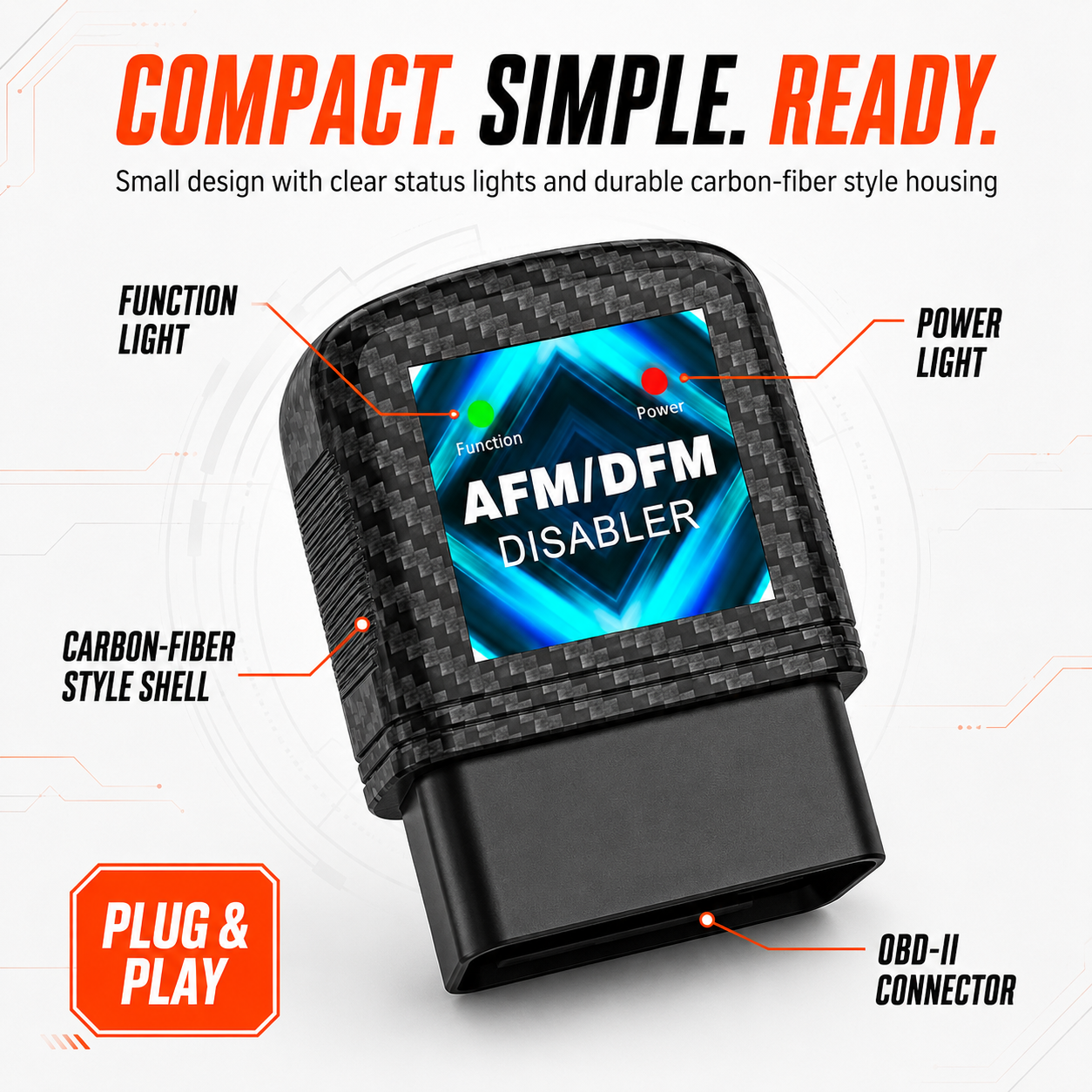
It sits on the OBD-II port and holds the engine in full-cylinder mode so the deactivation command is never issued. Pull it out and your truck is exactly as it left the factory.
Two ways. First, the LEDs: red POWER confirms it's live, green FUNCTION confirms it's holding full-cylinder mode.
Second - and this is the one owners notice the way the truck drives. Within the first ten miles most people report the same three things gone: no drone or pulsation at light cruise, no lurch when the engine comes back to eight cylinders, and no hunting or hesitation from the transmission when they ask for power.
Under the Magnuson-Moss Warranty Act, a dealer cannot void your warranty simply because an aftermarket part is installed - the burden is on them to show the part caused the failure.
In practice the bigger point is that FullBurn leaves nothing behind: it isn't a tune, it doesn't flash your ECU, and it writes nothing permanent.
Unplug it before a service visit and there is no trace it was ever there. That's not true of a handheld tuner, which leaves a flash counter the dealer can read.
Check before you order — this is the #1 complaint in the whole category and it's an avoidable one.
FullBurn fits select Chevrolet, GMC, Cadillac and Buick models, 2004–2024. It is not compatible with 10-speed transmissions, and 2022+ refresh models use a different ECM.
Confirm your year, engine and transmission on the fitment chart before checkout. If you're unsure, send us the year, model and engine and we'll tell you - including if the answer is no.
Standby draw is low, but it is not zero - nothing on a live OBD-II port is. For daily driving, leave it in.
If the vehicle is going to sit for more than a few days - storage, a trip, a seasonal truck - unplug it, the same as you would any OBD-II accessory.
It might. Real-world reports run from about +1 to −3 mpg depending on how you drive; we won't claim you'll gain any. Worth the context: when GM themselves built trucks without cylinder deactivation in 2021–2022 because of the chip shortage, the window-sticker penalty they published was 1 mpg.
One owner ran the math over 290,000 miles and figured the system had saved him roughly $490 in fuel. He'd already spent five figures on the engine.
Both work, and both cost you more than money. A tune runs $300–$650, is a permanent flash, and is visible to the dealer.
A mechanical delete is $873–$1,200 in parts and $2,500–$4,000+ installed — heads off, new camshaft, still needs a tune, truck down for days, and there is no going back. Inline modules run $599–$650 and have a documented habit of upsetting unrelated electronics.
FullBurn is the version you can undo: nothing flashed, nothing removed, nothing permanent.
Yes — they're different systems and both are covered. AFM (2005–2018, roughly) shuts down four fixed cylinders — 1, 4, 6 and 7 — and brings them back.
DFM (2019+) is more aggressive: the ECU re-decides the firing pattern up to 80 times a second across 17 patterns, with every cylinder independently switchable.
Either way it's the same mechanism doing the switching, and FullBurn holds both in full-cylinder mode.
Yes. Unplug it before the test and drive normally for a couple of hundred miles so the readiness monitors reset, then plug it back in afterward.
It takes five seconds each way. We'd rather tell you that now than have you find out at the testing station.
Our shipping typically takes 3-5 business days in the USA and 7-10 business days in other parts of the world.
If you are not completely satisfied, we are here to make it right.
We stand behind our products with a 30-day money-back guarantee.
Plus, our customer support team is always ready to assist with any questions or concerns.